What is Email Marketing? A Complete Beginner’s Guide (2026)
What is email marketing? You open your phone in the morning. Before checking Instagram or WhatsApp, you probably glance at your emails. You might see a sale notification from Myntra, a shipping update from Amazon, or a newsletter from your favourite blog.
That right there is email marketing in action.
Email marketing is one of the oldest and most powerful digital channels, and it still delivers incredible results in 2026. Whether you are a student learning digital marketing, a freelancer building clients, or a small business owner in India trying to grow online, email marketing is a skill you absolutely need to understand.
In this complete guide by MarketYug, you will learn what is email marketing, its meaning, types, how to do it step by step, key features, benefits, advantages, and disadvantages, and the best free tools available right now.
Let’s start from the very beginning.
- What is Email Marketing?
- Email Marketing Meaning
- Types of Email Marketing
- How to Do Email Marketing Step-by-Step
- Features of Email Marketing
- Benefits of Email Marketing
- Advantages and Disadvantages
- Best Free Email Marketing Tools in 2026
- Frequently Asked Questions
What is Email Marketing?
Email marketing is a digital marketing strategy where businesses and individuals send targeted emails to promote products, share useful content, build relationships, or drive sales.
In simple terms, it involves using email as a tool to reach the right people with the right message at the right time.
Think of it this way. Imagine you run a small clothing brand in Jaipur. You collect email addresses from people who visit your website or store. Each time you have a new collection or a sale, you send them an email. They open it, click on it, and many of them buy from you. That is email marketing.
Unlike social media, where your post might only reach 5 to 10% of your followers because of algorithms, an email goes directly to your subscriber’s inbox. That is what makes it so powerful and personal.
According to industry data, email marketing delivers an average return of ₹3,600 for every ₹100 spent, making it one of the highest ROI digital marketing channels.
Email Marketing Meaning (What Does It Really Mean?)
The meaning of email marketing goes beyond just sending promotional emails. It is a complete communication strategy that involves:
- Building an email list of people who are genuinely interested in what you offer
- Segmenting your audience based on their behaviour, location, or interests
- Sending personalised messages that feel relevant to each subscriber
- Automating your emails so the right message reaches the right person at the right time
- Measuring results like open rates, click rates, and conversions
In the context of digital marketing, it is the bridge between your brand and your audience. Social media creates awareness. SEO brings traffic. But it builds a loyal community that keeps coming back.
For example, Zomato sends you an email that says, “You haven’t ordered in a while,” with a discount code. That is not accidental; it is a carefully planned re-engagement email campaign designed to bring you back to the platform. That is the meaning of email marketing in the real world.
Types of Email Marketing
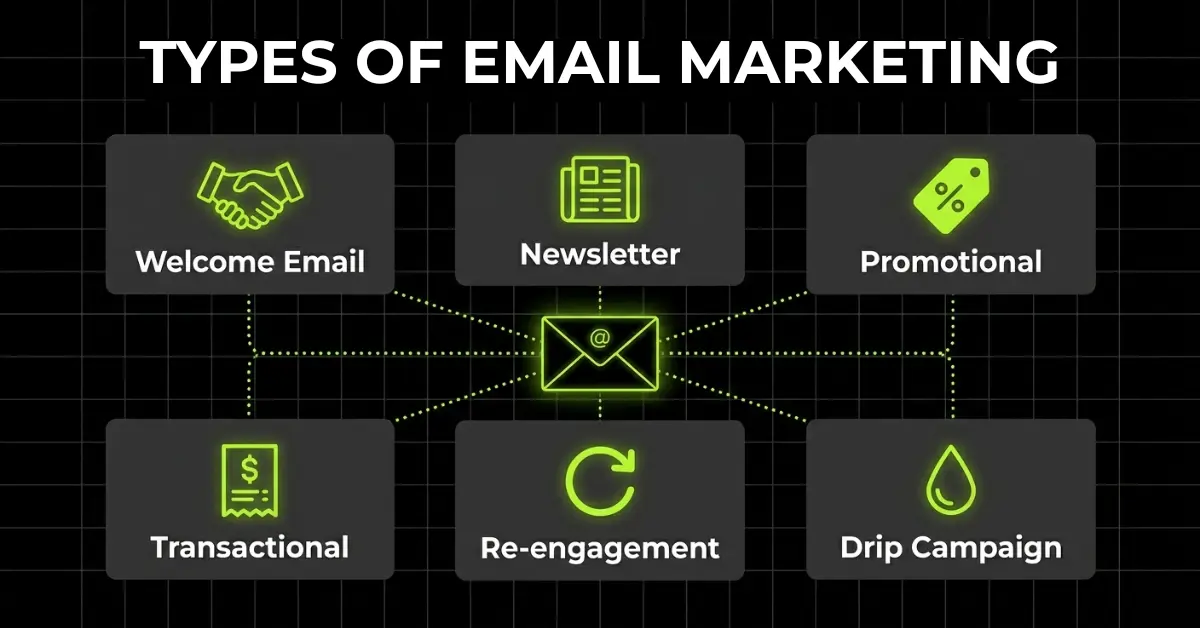
Not all marketing emails are the same. Different types of emails serve different purposes. Here are the main types of email marketing every beginner should know:
1. Welcome Emails
A welcome email is the first message a user gets after subscribing to your email list or signing up on your website. It sets the tone for future communication and creates the first impression.
Example: After signing up for MarketYug’s newsletter, subscribers get a welcome email introducing the blog and detailing the type of content they can expect.
Welcome emails usually have very high open rates, around 50 to 80 per cent, because the user has just taken action and is actively engaged at that moment.
2. Newsletter Emails
Newsletter emails are sent regularly to share updates, insights, tips, or curated content with your audience. Their main purpose is to keep subscribers interested and encourage them to return to your platform.
Example: A digital marketing blog like MarketYug may send a weekly newsletter featuring top marketing tips, recent blog posts, and a “tool of the week.”
These focus on providing consistent value instead of trying to sell directly.
3. Promotional Emails
Promotional emails aim to highlight a specific product, offer, discount, or event. They usually include a strong call to action, like “Shop Now,” “Get Your Discount,” or “Register Today.”
Example: An email promoting Flipkart’s Big Billion Days sale, complete with a countdown timer, featured deals, and a “Shop Now” button, is a typical promotional campaign.
4. Transactional Emails
Transactional emails are system-generated messages that are sent automatically after a user takes a specific action. They provide important information that the recipient expects.
Example: Order confirmations, shipping updates, password reset emails, or invoices. For instance, when you order from Swiggy and get an update like “Your order is on the way,” that’s a transactional email.
5. Re-Engagement Emails
Re-engagement emails are sent to inactive subscribers who haven’t interacted with your emails for a while. The goal is to bring them back.
Example: A message like “We miss you! Enjoy 15% off your next order” encourages users to engage again with your brand.
6. Drip Email Campaigns
A drip campaign is a series of automated emails sent over time to guide users through a journey, from awareness to conversion.
Example: If someone downloads a free checklist from MarketYug, they might receive five emails over ten days. Each email offers valuable insights, builds trust, and gradually nudges them toward taking the next step.
How to Do Email Marketing Step-by-Step for Beginners
Now that you know the types, let’s get practical. Here is exactly how to do email marketing from scratch, even if you are a complete beginner.
Step 1: Pick an Email Marketing Platform
Start by choosing an easy-to-use email marketing tool. Platforms like Mailchimp, MailerLite, or Brevo are great options. They let you manage subscribers, create emails, and track performance all in one place.
Step 2: Offer Something Valuable (Lead Magnet)
People won’t share their email without a good reason. Offer them something useful in return, like an ebook, checklist, discount, or short course. This is called a lead magnet.
Example: A free “Digital Marketing Roadmap for Beginners” attracts new readers to a blog.
Step 3: Grow Your Subscriber List
Add signup forms throughout your website, such as on the homepage, blog posts, and sidebars, to collect visitors’ emails. Aim to build your list naturally. A smaller, engaged audience is much more valuable than a large, uninterested one.
Step 4: Organize Your Audience (Segmentation)
Your subscribers will have different needs and interests. Group them based on behaviour, interests, or experience level so you can send more personalized content.
Example: Separate users into categories like beginners, advanced learners, or business owners.
Step 5: Craft an Engaging Subject Line
The subject line is your first impression; it decides if your email gets opened. Keep it short, clear, and interesting.
Examples:
“5 Email Marketing Mistakes You Should Avoid”
“Why Digital Marketing is Important”
“How one creator reached 10,000 readers using email”
Step 6: Keep the Email Design Simple
Make your emails clean, easy to read, and mobile-friendly. Use short paragraphs, limit images, and focus on one clear call-to-action so readers know what to do next.
Step 7: Test Before You Send
Always preview and test your email before sending it to your entire list. Check formatting, links, and how it looks on mobile devices to catch any mistakes.
Step 8: Measure and Improve
After sending, look at your performance metrics:
Open Rate: Who opened your email
Click Rate: Who interacted with the links
Unsubscribes: Those who opted out
Conversions: Who completed your goal
Use this data to refine and improve future campaigns.
Features of Email Marketing
What makes email marketing so effective? Here are the key features of email marketing that separate it from every other marketing channel:
- Automation
You can set up emails to send automatically based on triggers, like when someone signs up, makes a purchase, or hasn’t visited in 30 days. This saves hours of manual work every week.
- Personalisation
Email marketing tools allow you to address subscribers by their first name and send content based on their past behaviour or preferences. Personalised emails get much higher open and click rates than generic mass emails.
- Segmentation
You can divide your email list into groups and send targeted messages. The more relevant the email, the better the results. A segmented campaign can perform up to three times better than a non-segmented one.
- A/B Testing
Test two versions of an email, such as different subject lines, designs, or calls to action, to see which one performs better. This helps you improve by using real data rather than guessing.
- Detailed Analytics
Every email campaign gives you data on opens, clicks, bounces, and conversions. Unlike a social media post or a pamphlet, you know exactly how your email performed and why.
- Mobile Optimisation
Modern email marketing tools automatically adjust your emails for mobile devices, ensuring a great experience for most readers who open emails on their smartphones.
- Cost-Effective Delivery
You can reach thousands of subscribers for almost no cost, especially with free plans from major email marketing tools. This makes it accessible to beginners and small businesses on any budget.
Benefits of Email Marketing
Here are the top benefits of email marketing that make it a must-have for every digital marketer, blogger, and business owner in 2026:
- Incredibly High ROI
Email marketing consistently delivers one of the highest returns of any marketing channel. For businesses in India, this means getting more results while spending less compared to paid ads.
- Direct Access to Your Audience
Unlike social media platforms that can limit your reach overnight because of algorithm changes, your email list is completely yours. No platform decides who sees your message.
- Builds Long-Term Relationships
Regular, valuable emails help create real trust with your audience over time. People buy from brands and creators they trust. Email is the most personal digital communication channel available.
- Drives Consistent Traffic to Your Website
Every email you send is an opportunity to bring readers back to your blog, product page, or landing page. For content creators, this is a strong traffic source that works on demand.
- Fully Measurable and Trackable
You will always know what is working and what isn’t. This data-driven approach lets you keep improving your campaigns and grow results over time.
- Works for Every Business Size
Whether you are a solo blogger, a freelancer, a startup, or an established brand, email marketing works for every size and in every niche.
- Supports All Other Marketing Channels
Email marketing boosts your SEO, content marketing, and social media efforts by keeping your audience engaged, informed, and connected to your brand on a deeper level.
Advantages and Disadvantages of Email Marketing
Like every marketing channel, email marketing has both strengths and limitations. Here is an honest look at the advantages and disadvantages of email marketing:
| Advantages | Disadvantages |
| Very cost-effective, even free to start | Emails can land in the spam folder |
| High ROI compared to other channels | Building a quality email list takes time |
| Direct and personal communication | Risk of high unsubscribe rates if the content is poor |
| Easy to automate and scale | Requires consistent effort and content creation |
| Fully measurable with analytics | Design must be mobile-friendly to perform well |
| You own your email list | Subscribers can experience “email fatigue” if over-mailed |
| Works across all industries and niches | Deliverability is affected by the sender’s reputation |
Key Takeaway: The disadvantages are manageable with the right strategy. If you provide genuine value, send emails at the right frequency, and respect your subscribers, the advantages of email marketing far outweigh the challenges for any business or creator.
Best Free Email Marketing Tools in 2026
Here are the best free email marketing tools available in 2026:
- Mailchimp
Free Plan: Up to 500 contacts, 1,000 emails per month
Mailchimp is the most popular email marketing tool for beginners worldwide. It offers a drag-and-drop email builder, basic automation, and detailed analytics. The free plan is perfect for anyone just starting with email marketing.
Best for: Beginners and bloggers
- Brevo (formerly Sendinblue)
Free Plan: Unlimited contacts, 300 emails per day (about 9,000 per month)
Brevo is a great option because it allows you to store unlimited contacts, even on the free plan, which is a big advantage over competitors. It also includes SMS marketing, making it a flexible tool for marketers in India.
Best for: Small businesses and freelancers
- MailerLite
Free Plan: Up to 1,000 subscribers, 12,000 emails per month
MailerLite has one of the cleanest and most user-friendly interfaces available. It includes automation, landing pages, and pop-up forms, all offered on the free plan. It provides excellent value for content creators and bloggers.
Best for: Bloggers and content creators
- HubSpot Email Marketing
Free Plan: Unlimited contacts, 2,000 emails per month
HubSpot’s free email marketing tool is part of its larger CRM platform. If you want to combine email marketing with full contact management and sales tracking, this is the most powerful free choice available.
Best for: Businesses and marketers who want CRM integration
- Zoho Campaigns
Free Plan: Up to 2,000 contacts, 6,000 emails per month
Zoho Campaigns is a user-friendly tool for India, featuring strong localization, robust automation, and smooth integration with other Zoho products that are widely used by Indian businesses and startups.
Best for: Indian businesses already using the Zoho suite
Conclusion
Email marketing is not going anywhere. In fact, in 2026, with increasing noise on social media and rising ad costs, email marketing is more valuable than ever before.
Let’s do a quick recap of everything you learned in this guide:
- What is email marketing — a strategy to reach your audience directly through personalised, targeted emails
- Email marketing meaning — communication that builds relationships and trust, not just sells products
- Types of email marketing — welcome, newsletters, promotional, transactional, re-engagement, and drip campaigns
- How to do email marketing — choose a tool, build a genuine list, segment, design, send, and analyse
- Features of email marketing — automation, personalisation, segmentation, A/B testing, and deep analytics
- Benefits of email marketing — high ROI, direct access, trust-building, consistent traffic, and full measurability
- Advantages and disadvantages — powerful when done right, but requires consistency and a subscriber-first approach
- Free email marketing tools — Mailchimp, Brevo, MailerLite, HubSpot, and Zoho Campaigns
Now it is your turn. Pick one free tool from this list, set up your first signup form on your website, create a simple lead magnet, and start building your email list today. You do not need a big budget or technical skills; you just need to start.
Your email list is an asset that grows more valuable with every subscriber you add.
Want to keep learning digital marketing from scratch, step by step? Explore more beginner-friendly guides at MarketYug.
Explore our other guides below:
- What is SEO and how does it work?
- How to start affiliate marketing in India (2026 guide)
- What are backlinks and why do they matter for SEO?
Frequently Asked Questions (FAQ)
Q1. What is email marketing in simple words?
Email marketing is sending targeted, valuable emails to people who have shown interest in your brand. You do this to promote products, share content, or build a long-term relationship.
Q2. Is email marketing still effective in 2026?
Yes, definitely. Email marketing still provides one of the highest returns of any digital marketing channel. With social media ad costs going up and organic reach declining, email is more important than ever.
Q3. How do I start email marketing as a beginner?
Begin with a free tool like Mailchimp or MailerLite. Create a simple signup form on your website. Offer a helpful lead magnet, like a free guide or checklist, and start sending valuable emails to your growing list.
Q4. What is the best free email marketing tool for beginners in India?
Mailchimp and MailerLite are great free options for beginners because they have simple interfaces and generous free plans. For Indian businesses, Zoho Campaigns or Brevo are also strong choices.
Q5. What are the main types of email marketing?
The main types are welcome emails, newsletters, promotional emails, transactional emails, re-engagement emails, and automated drip campaigns.
Q6. What are the disadvantages of email marketing?
The main disadvantages include the chance of ending up in spam folders, the time it takes to build a quality email list, and possible subscriber fatigue if emails are sent too often or lack genuine value.