What Is SEO and How It Works: The Complete Beginner Guide (2026)
If you have ever typed a question into Google and clicked one of the top results, you have already experienced SEO from the other side.
Now imagine being the website that appears at the top.
That is what SEO does for you. And in this guide, I am going to break down what is SEO and how it works, explain why it matters more than ever in 2026, cover the main types of SEO, show you how to do keyword research, and share the best free keyword research tools for beginners, all in plain, simple language.
I run MarketYug, a digital marketing blog based in India, and everything I share here comes from real experience, not theory.
Let’s get into it.
What Is SEO?
SEO (Search Engine Optimization) is the process of improving your website so it shows up higher in search engine results, like Google, Bing, or YouTube, when someone searches for topics related to your content, product, or service.
In simple terms, SEO helps the right people find your website for free. When you search “best smartphones under 20,000” or “how to start a blog,” Google does not show results randomly. It uses hundreds of signals to determine which pages are the most relevant, trustworthy, and useful. SEO is what you do to ensure your website meets those signals.
Think of it this way: Google is like a librarian managing billions of web pages. SEO is how you make sure your book is well-labelled, easy to find, and genuinely useful, so the librarian recommends it first.
According to Google’s own Search documentation, the goal of SEO is not to trick search engines. It is to help them understand your content better so they can connect it with the right searchers. The traffic you get from SEO is called organic traffic, meaning you did not pay for it. Unlike ads, which stop as soon as you stop paying, SEO builds an asset that continues to work for you over time.
How SEO Works (Step-by-Step)
To understand how SEO Works, you first need to know what happens inside Google before your result appears. There are four main stages:
Stage 1: Crawling
Google uses automated programs called crawlers, also known as spiders or bots, to continuously browse the internet. They move from page to page by following links, just like you do when you click through a website.
When a crawler visits your page, it reads your content, notes your links, and reports back to Google’s servers.
Here’s what this means for you:
- Ensure all your pages have internal links pointing to them.
- Fix broken links, as crawlers can get stuck on dead ends.
- Use a clear site structure so bots can navigate easily.
- Submit a sitemap via Google Search Console, so Google knows about all your pages.
- If Google’s crawler cannot reach your page, it will never show up in search results, no matter how good your content is.
Stage 2: Indexing
After a page is crawled, Google analyzes it and stores it in its vast database, known as the index. Think of the index as Google’s private library holding billions of web pages, all organized by topic.
During indexing, Google tries to understand:
- What is this page about?
- Is the content original or copied?
- What language is it in?
- Is it high quality and helpful?
- What keywords and topics does it cover?
Pages that are clear, original, and well-structured get indexed correctly. Pages with thin content, duplicate text, or technical errors might be skipped.
You can check if your pages are indexed by typing site:yourwebsite.com in Google. If your page appears, it is indexed. If not, you may have a technical issue to resolve.
Stage 3: Ranking
When someone types a search query, Google scans its index and picks the pages it thinks will best answer the query. It then ranks them in order, and that ordered list is what you see as search results.
Google uses over 200 ranking factors to make this decision. The most important include:
- Relevance: Does your content match what the user is searching for?
- Content quality: is it detailed, accurate, and genuinely helpful?
- Backlinks: Do other credible websites link to your page?
- Page speed: Does your page load quickly?
- Mobile-friendliness: does it work well on smartphones?
- User experience: do visitors stay and engage, or leave immediately?
No single factor determines your ranking. SEO involves consistently doing many things well.
Stage 4: Understanding Search Intent
This is the most crucial concept in modern SEO, and many beginners overlook it.
Search intent refers to the reason behind a search. Before writing any content, ask yourself: what does the person searching this keyword actually want?
There are four types of search intent:
| Intent Type | What the User Wants | Example Query |
|---|---|---|
| Informational | To learn something | “What is SEO?” |
| Navigational | To find a specific site | “Google Search Console login” |
| Commercial | To compare before buying | “best SEO tools 2026” |
| Transactional | To buy or sign up | “Buy the SEMrush plan” |
If someone searches “what is SEO,” they want a clear, beginner-friendly explanation, not a sales page. If your content meets their needs, Google will rank it if it answers the question well; otherwise, it won’t.
Why SEO Is Important in 2026
Understanding why SEO is important can completely change how you grow online.
1. Free and Consistent Traffic
Unlike paid ads, SEO brings long-term traffic without ongoing costs.
For instance:
A student writes a blog on “How to Learn Digital Marketing Step by Step”.
After 3-4 months, the blog is ranked and gets 1,000+ visitors per month without ads.
Paid ads will stop when the budget runs out. The SEO traffic will not stop.
2. Builds Trust and Authority
Websites that rank higher are seen as more reliable by users.
For instance:
When users search “best digital marketing tools” and find your website on the top results, they automatically trust your website more than websites on page 3.
Higher ranking = higher credibility.
3. Better User Experience
SEO improves page speed, structure, and readability.
For instance:
You optimize:
- Fast loading
- Clear headings
- Mobile-friendly layout
Users stay longer → Google notices → rankings improve.
4. Higher Conversion Rates
SEO targets people already searching for your solution.
For instance:
Someone searches “SEO services for small business”.
They already want SEO help.
If your page ranks, conversion chances are very high.
This is why SEO is important for bloggers, startups, and businesses of all sizes.
Main Types of SEO
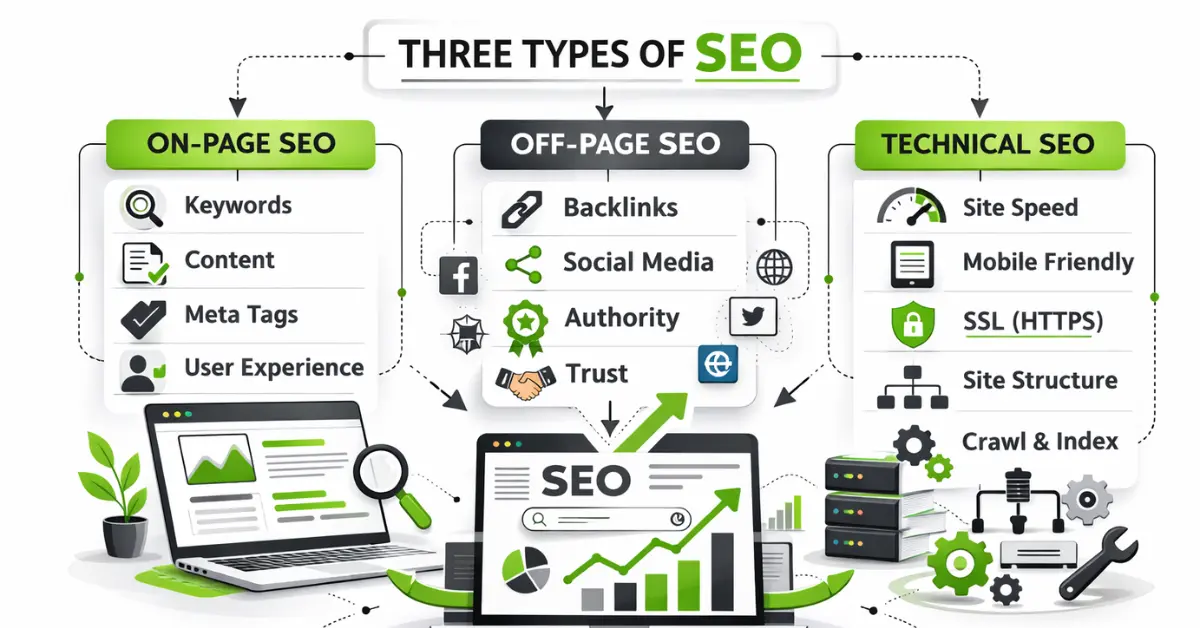
SEO is not a single task, such as adding keywords or writing articles. It is a combination of different methods that work together to improve your website’s performance and visibility. For better understanding, SEO is divided into three major types:
- On-Page SEO
- Off-Page SEO
- Technical SEO
Each type plays a different role.
What Is On-Page SEO?
On-page SEO covers everything you do on your web pages to make them relevant and useful for search engines and users.
It includes:
Title Tag:
The headline that shows up in Google search results. It should have your main keyword and give users a clear reason to click.
Meta Description:
The brief description under your title in the search results. It doesn’t directly impact rankings, but a good meta description increases click-through rates.
Headings (H1, H2, H3):
A proper heading structure helps Google understand the hierarchy of your content. Your H1 should have your main keyword. H2S and H3S should address subtopics.
Keyword Placement:
Your target keyword should fit naturally into your title, the first paragraph, some headings, and the body of your content. Never cram keywords in unnaturally.
Internal Links:
links to other relevant pages on your website. These help Google understand your site structure and keep users engaged longer.
Image Optimization:
Every image should have a descriptive alt text. This helps Google index your images and makes your site more accessible.
URL Structure:
Clean URLs that include keywords perform better. For example, marketyug.com/what-is-seo is better than marketyug.com/p=1653.
Content Depth:
Google prefers to rank pages that thoroughly answer a searcher’s question. Shallow, surface-level content seldom ranks for competitive keywords.
What Is Off-Page SEO?
Off-page SEO involves actions taken outside your website that affect how search engines view your authority and trustworthiness. The most important factor in off-page SEO is backlinks, which are links from other websites to yours. When a trusted site links to your page, Google sees it as a vote of confidence. This means that “this content is reliable enough that another site can reference it.”
Not all backlinks hold the same value. A link from a high-authority website, like a national news outlet or a popular industry blog, is much more valuable than many links from low-quality directories.
Other off-page SEO factors include:
- Brand mentions: even unlinked mentions of your brand name build authority over time.
- Social signals: content that gets widely shared often attracts more backlinks.
- Writing guest articles: writing articles for other blogs related to your topic and linking to your site.
- Digital PR: getting featured in media publications or industry roundups.
Off-page SEO takes time. It builds by consistently producing content so useful that others want to link to it.
What Is Technical SEO?
Technical SEO focuses on the backend structure and performance of your website. Even with great content, Google may struggle to crawl, index, or rank it if there are technical issues. Key areas of technical SEO include:
Page Speed:
Google has confirmed that page speed is a ranking factor, especially on mobile. Use Google’s PageSpeed Insights to review your score and follow its advice.
Mobile-Friendliness:
over 60% of Google searches now occur on mobile devices. Google uses mobile-first indexing, meaning it primarily looks at your mobile version for rankings.
HTTPS (Secure Connection):
If your website still uses HTTP instead of HTTPS, this needs urgent attention. Google marks non-HTTPS sites as “Not Secure,” which harms trust and rankings.
XML Sitemap:
A sitemap shows Google all the pages on your website. Submit it using Google Search Console.
Robots.txt:
This file tells Google which pages to crawl and which to skip. A wrongly set up robots.txt can unintentionally block your entire site from being indexed.
Core Web Vitals:
a set of metrics from Google measuring loading speed (LCP), interactivity (INP), and visual stability (CLS). These directly impact rankings.
Schema Markup:
structured data that helps Google better understand your content. For instance, adding FAQ schema to a blog post can lead to rich results (expanded snippets) in search results, giving you more visibility in SERP without needing to rise in position.
Why All Three Types Are Important
Think of SEO like opening a new shop:
On-Page SEO → Clean shop, organized products, clear price tags
Off-Page SEO → People recommending your shop to others
Technical SEO → Good road access, parking, and electricity
If anyone is missing, your business suffers.
How to Do Keyword Research for Beginners
Learning how to do keyword research is the foundation of SEO. Keyword research helps you understand what people are searching for and how competitive those searches are.
Begin by identifying topics relevant to your niche. Then, find keywords users actually type into search engines. Analyze search intent—whether users want information, products, or services.
Effective keyword research helps:
- Target the right audience
- Reduce competition
- Improve ranking potential
Without keyword research, SEO efforts are often unfocused and ineffective.
For instance:
You want to write about SEO.
Instead of guessing, you find:
- “What is SEO and how it works” – good intent
- “How to do SEO” – beginners searching
- “best free keyword research tool” – low competition
Now you create content based on real searches, not assumptions.
Best Free Keyword Research Tool
You do not need to spend money to do keyword research. Here are the best free tools to start with:
1. Google Search Console
If you already have a website, this is the first tool to set up. It shows you which keywords your site already ranks for, your average position, impressions, and click-through rates. It is completely free and directly from Google.
2. Google Keyword Planner
Originally built for Google Ads, Keyword Planner gives you keyword ideas, monthly search volumes, and competition levels. Create a free Google Ads account to access it.
3. Google Search Suggestions (Autocomplete)
Type any keyword into Google and look at what Google suggests to complete your phrase. These suggestions are based on real searches. Scroll to the bottom for “People also search for” — pure keyword gold.
4. Answer The Public
Enter a seed keyword and get a visual map of all the questions people ask around that topic. Perfect for finding informational keyword ideas and blog post topics.
5. Ubersuggest (Free Tier)
Neil Patel’s Ubersuggest offers keyword suggestions, search volume estimates, and basic SEO difficulty scores on its free plan. Good for beginners.
6. Google Trends
See how interest in a keyword changes over time. Useful for spotting seasonal trends or emerging topics before they become competitive.
Pro tip: Start with Google Search Console and Google autocomplete. They give you real data directly from Google — no third-party estimation needed.
SEO Best Practices for Long-Term Growth
To succeed with SEO, follow best practices consistently:
- Focus on user intent, not just keywords
- Avoid keyword stuffing
- Write for humans first
- Optimize images properly
- Track performance regularly
SEO success comes from patience, quality, and continuous improvement.
Is SEO Still Relevant in 2026?
Yes. SEO remains highly relevant because search behaviour continues to grow. While AI and voice search are evolving, the core principles of what is SEO and how it works remain the same: delivering the best answer to users.
Websites that prioritise helpful content and user experience will continue to benefit from SEO in the future.
For instance:
AI tools give answers, but people still:
- Search products
- Compare services
- Read guides
Websites with helpful, structured content continue to rank.
SEO evolves, but it never disappears.
Conclusion
Understanding what is SEO and how it works is the first real step toward growing your website on Google. It is not complicated once you break it down:
Search engines crawl and index your pages, then rank them based on relevance, authority, and user experience. Your job is to create content that is genuinely helpful, technically accessible, and trustworthy enough to earn links.
By mastering the main types of SEO, practicing how to do keyword research, using the best free keyword research tools, and consistently following SEO best practices, you build something most websites do not have: long-term, compounding organic traffic.
At MarketYug, we believe SEO is a long-term investment that delivers sustainable success when done right, and if you learn What Is Digital Marketing in Simple Words, read my blog.
FAQ
1. Is SEO better than paid advertising?
SEO is better for long-term growth because it provides consistent traffic without ongoing costs. Paid ads deliver instant results but stop as soon as the budget runs out.
2. Can I do SEO without technical knowledge?
Yes, beginners can do SEO without deep technical knowledge by focusing on content, keywords, and basic on-page optimization. You can learn technical SEO over time.
3. Is SEO still important in 2026?
Yes, SEO is even more important in 2026 because people continue to search online for information, products, and services before making decisions.
4. How can beginners do SEO?
Beginners can do SEO by following these simple steps:
- Do keyword research
- Create helpful content
- Optimize titles, headings, and images.
- Improve website speed and mobile usability.
- Build quality backlinks
5. How do I conduct keyword research?
You can conduct keyword research by finding out what users search for on Google. Analyze search intent, search volume, and competition to choose the right keywords for your content.
6. Why is SEO important for a website?
SEO is important because it brings free organic traffic, builds trust, improves user experience, and helps websites grow long-term without relying solely on paid ads.