
What Is SEO and How It Works: A Complete Beginner Guide by MarketYug
What is SEO and how it works is one of the most important questions for anyone starting a website, blog, or online business today. Whether you are a student, freelancer, business owner, or content creator, understanding SEO is essential to succeed online. At MarketYug, we believe SEO is not just a marketing skill but a long-term digital asset.
SEO is the process that helps users find your website on search engines like Google when they search for information related to your niche. Without SEO, even the best websites can struggle to attract customers. visitors. This guide outlines why SEO is important, the main types of SEO, and shows you how to practice SEO effectively, introduces the best free keyword research tools, all explained in simple, beginner-friendly language.
What Is SEO?
SEO is a digital marketing technique that helps websites get free (organic) traffic from search engines. When someone searches for a query, Google shows results that it believes are most useful. SEO helps your website become one of those results.
Every time people search for answers, products, or services on the internet, search engines have to scan an enormous number of web pages to pick the ones they think are the most useful and relevant. SEO can help your website meet the requirements of search engines as well as the expectations of your visitors.
In short, SEO is a process that connects three things:
- The search queries that people enter into search engines
- The information or solutions that you provide
- The attention that your website receives
When you know how SEO works, you can develop content that will attract the right audience and generate traffic without having to depend on advertisements.
How SEO Works (Step-by-Step)
To understand How SEO Works, you need to know what happens inside a search engine before a website shows up in the results. Search engines follow a clear process to find pages, organize them, and decide which ones should appear first. SEO helps your website fit into this system so it can be found and ranked.
1. Crawling
Search engines send automated programs called crawlers or bots to explore the internet. These bots move from one page to another by following links.
Their job is to:
- Find new web pages
- Detect updated content
- Read website structure and internal links
If your website has clear navigation, working links, and no technical errors, crawlers can access your content more easily. Pages that cannot be crawled will not appear in search results.
2. Indexing
After a page is found, the search engine studies the content and saves it in its database, called the index. You can think of this as a digital library where every page is sorted by topic.
Here, the search engine looks at:
- The main topic of the page
- Important keywords and headings
- Content quality and originality
- Images and other media
Clear, well-written, and useful content has a higher chance of being stored correctly. In contrast, copied or poor content may be ignored.
For instance:
Your blog title:
“What Is SEO and How It Works – Beginner Guide”
Google understands:
- Topic: SEO basics
- Keywords: what is SEO, how SEO works
- Content quality: original and helpful
Then Google stores it in its index.
3. Ranking
When someone types a query into a search engine, it scans its index and selects the most relevant pages. These pages are then arranged in order of importance and usefulness.
Ranking decisions are influenced by many factors, including:
- Relevance to the search query
- Content depth and accuracy
- Website authority and backlinks
- Page speed and mobile-friendliness
- Overall user experience
The better your SEO strategy, the stronger your chances of appearing higher in search results.
4. Matching Search Intent
Search engines also try to understand the purpose behind a user’s search. This is called search intent.
For instance:
- Someone searching “how to learn SEO” wants a guide
- Someone searching “buy SEO course” wants a product or service
Web pages that closely match what the user expects are ranked higher because they provide the most relevant experience.
Why SEO Is Important
Understanding why SEO is important can completely change how you grow online.
1. Free and Consistent Traffic
Unlike paid ads, SEO brings long-term traffic without ongoing costs.
For instance:
A student writes a blog on “How to Learn SEO Step by Step”.
After 3-4 months, the blog is ranked and gets 1,000+ visitors per month without ads.
The paid ads will stop when the money stops. The SEO traffic will not stop.
2. Builds Trust and Authority
Websites that rank higher are seen as more reliable by users.
For instance:
When users search “best digital marketing blog in India” and find your website on the top results, they automatically trust your website more than websites on page 3.
Higher ranking = higher credibility.
3. Better User Experience
SEO improves page speed, structure, and readability.
For instance:
You optimize:
- Fast loading
- Clear headings
- Mobile-friendly layout
Users stay longer → Google notices → rankings improve.
4. Higher Conversion Rates
SEO targets people already searching for your solution.
For instance:
Someone searches “SEO services for small business”.
They already want SEO help.
If your page ranks, conversion chances are very high.
This is why SEO is important for bloggers, startups, and businesses of all sizes.
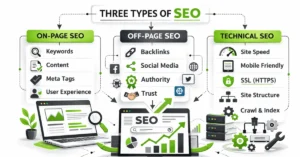
Main Types of SEO
SEO is not a single task, such as adding keywords or writing articles. It is a combination of different methods that work together to improve your website’s performance and visibility. For better understanding, SEO is divided into three major types:
- On-Page SEO
- Off-Page SEO
- Technical SEO
Each type plays a different role.
1. On-Page SEO
On-page SEO is all the work you do on your website to make it useful, understandable, and clear to both users and search engines.
Search engines attempt to understand:
- What your page is all about
- Is the information useful?
- Is there value in it for visitors?
To make search engines understand this, you need to optimize your page content and structure.
2. Off-Page SEO
Off-Page SEO refers to all the activities you do outside your own website to make your website appear trustworthy and popular on the internet.
Your website alone cannot convince search engines that your business is good. Search engines also check what others say about you on the internet.
You can understand it like:
-
Backlinks from trusted websites
-
Brand mentions
-
Social sharing
If many people in your city recommend a shop, you now trust that shop. The same thing happens on the internet.
If many trustworthy websites mention or recommend your website, search engines understand:
“People trust this website, so it must be useful.”
3. Technical SEO
Technical SEO focuses on the backend and performance of the website.
Even if your content is excellent, Google may not rank your site if it cannot properly access or load it.
Important Parts of Technical SEO
1. Website Speed (Fast Loading)
Users leave a slow website quickly.
If your site takes 6 seconds to load, most visitors will close it.
Example:
An online mobile shop loads slowly → users go back to Google → click another website → your ranking drops.
2. Mobile Friendliness
Today, most searches happen on mobile phones.
If your website:
- The text is too small
- The buttons are hard to click
- Google will rank it lower.
For instance:
A tuition teacher’s site works perfectly on a laptop, but not on the phone; students cannot contact → ranking decreases.
3. Secure Website (HTTPS)
Your website should have a security certificate.
You see:
https:// instead of http://
Google prefers secure websites because they protect user data (like contact forms or payments).
4. Proper Indexing
Google must be able to read and store your pages in its database (called indexing).
If pages are not indexed:
They will never appear in search results, no matter how good the content is.
Why All Three Types Are Important
Think of SEO like opening a new shop:
On-Page SEO → Clean shop, organized products, clear price tags
Off-Page SEO → People recommending your shop to others
Technical SEO → Good road access, parking, and electricity
If anyone is missing, your business suffers.
How to Do Keyword Research
Learning how to do keyword research is the foundation of SEO. Keyword research helps you understand what people are searching for and how competitive those searches are.
Begin by identifying topics relevant to your niche. Then find keywords users actually type into search engines. Analyze search intent—whether users want information, products, or services.
Effective keyword research helps:
- Target the right audience
- Reduce competition
- Improve ranking potential
Without keyword research, SEO efforts are often unfocused and ineffective.
For instance:
You want to write about SEO.
Instead of guessing, you find:
- “What is SEO and how it works” – good intent
- “How to do SEO” – beginners searching
- “best free keyword research tool” – low competition
Now you create content based on real searches, not assumptions.
Best Free Keyword Research Tool
Choosing the best free keyword research tool is important for beginners and small businesses. Free tools help you discover keyword ideas without investing money.
Some reliable free options include:
- Google Keyword Planner
- Google Search suggestions
- Google Search Console
- Answer-based keyword tools
At MarketYug, we recommend starting with free tools to understand search demand before moving to paid solutions.
SEO Best Practices for Long-Term Growth
To succeed with SEO, follow best practices consistently:
- Focus on user intent, not just keywords
- Avoid keyword stuffing
- Write for humans first
- Optimize images properly
- Track performance regularly
SEO success comes from patience, quality, and continuous improvement.
Is SEO Still Relevant in 2026?
Yes. SEO remains highly relevant because search behaviour continues to grow. While AI and voice search are evolving, the core principles of what is SEO and how it works remain the same: delivering the best answer to users.
Websites that prioritise helpful content and user experience will continue to benefit from SEO in the future.
For instance:
AI tools give answers, but people still:
- Search products
- Compare services
- Read guides
Websites with helpful, structured content continue to rank.
SEO evolves, but it never disappears.
Conclusion
Understanding what is SEO and how it works is essential for anyone serious about online growth. SEO is not about shortcuts—it’s about creating value, building trust, and optimizing for users and search engines.
By learning why SEO is important, mastering the main types of SEO, knowing how to do SEO, practicing how to do keyword research, and using the best free keyword research tool, you build a strong digital foundation.
At MarketYug, we believe SEO is a long-term investment that delivers sustainable success when done right, and if you learn What Is Digital Marketing in Simple Words, read my blog.
FAQ
1. Is SEO better than paid advertising?
SEO is better for long-term growth because it provides consistent traffic without ongoing costs. Paid ads deliver instant results but stop as soon as the budget runs out.
2. Can I do SEO without technical knowledge?
Yes, beginners can do SEO without deep technical knowledge by focusing on content, keywords, and basic on-page optimization. You can learn technical SEO over time.
3. Is SEO still important in 2026?
Yes, SEO is even more important in 2026 because people continue to search online for information, products, and services before making decisions.
4. How can beginners do SEO?
Beginners can do SEO by following these simple steps:
- Do keyword research
- Create helpful content
- Optimize titles, headings, and images.
- Improve website speed and mobile usability.
- Build quality backlinks
5. How do I conduct keyword research?
You can conduct keyword research by finding out what users search for on Google. Analyze search intent, search volume, and competition to choose the right keywords for your content.
6. Why is SEO important for a website?
SEO is important because it brings free organic traffic, builds trust, improves user experience, and helps websites grow long-term without relying solely on paid ads.
Pingback: What Is Digital Marketing in Simple Words – MarketYug
Pingback: How to Do SEO: Beginner to Advanced Guide | MarketYug