How to Learn Digital Marketing Step by Step in 2026 (Beginner Roadmap)
If you search “how to learn digital marketing” on Google right now, you will find hundreds of articles telling you to “just start with SEO” or “watch YouTube videos.” That advice is technically not wrong. But it skips the most important part: knowing what to learn, in what order, and how to practice it without wasting months.
This guide gives you that structure. It is designed specifically for beginners in India, students, freshers, freelancers, and small business owners who want to build real, employable digital marketing skills in 2026.
You will find a clear learning roadmap, the best free courses with links, honest salary expectations, tool recommendations, and a step-by-step action plan you can start today.
Table of Contents
- What is digital marketing?
- Who should learn digital marketing in 2026?
- The 2026 digital marketing roadmap for beginners
- Step-by-step guide to learning digital marketing
- Best free courses and certifications
- Essential tools every beginner needs
- Digital marketing salary in India (2026 data)
- Career paths in digital marketing
- Common mistakes to avoid
- Frequently asked questions
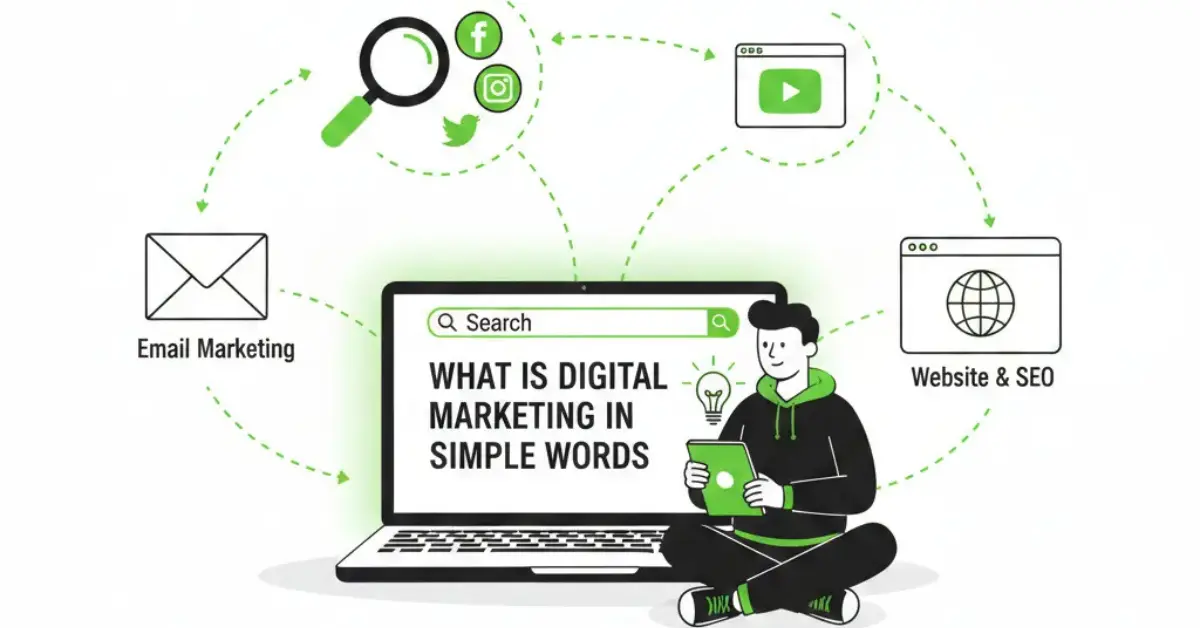
What Is Digital Marketing
Digital marketing is the promotion of products, services, or oneself using digital channels such as search engines, social media, email, websites, and advertising.
Whereas conventional marketing involves tools such as TV advertisements, newspapers, and banners, digital marketing offers you an edge that others lack: knowing what works and making adjustments where necessary in real-time.
If you own a small store and learn about SEO, you’ll find yourself appearing on Google when someone searches for “mobile accessories shop near me,” all for free. If you are a professional freelancer who has learned about Meta Ads, you can work for your clients who need marketing services in Mumbai right from your office in Jaipur. This is what digital marketing enables you to do.
Some of the most important digital marketing channels include:
- SEO – Appearing on Google organically
- SEM / PPC – Running Google Ads
- Social Media Marketing – Using social media such as Instagram, LinkedIn, and YouTube
- Content Marketing – Blog posts, videos, infographics, and podcasts
- Email Marketing – Building relationships with clients via emails
- Affiliate Marketing – Generating income through affiliate marketing
- Performance Marketing – Data-driven paid campaigns
For instance:
A small mobile accessories shop owner created a simple website and listed the business on Google. By learning basic SEO and using Google Search Console, the shop started appearing in local searches like “mobile accessories shop near me.” Within 3 months, walk-in customers increased without running any paid ads.
Who Should Learn Digital Marketing in 2026?
Digital marketing is one of the most versatile skills you can build in 2026. It works for nearly every goal:
| Your situation | How digital marketing helps |
|---|---|
| College student | Build a portfolio before graduation. Land jobs that pay ₹3–5 LPA as a fresher. |
| Job seeker | One of the top 5 in-demand skills in India. High hiring across startups, agencies, and brands. |
| Freelancer | Earn ₹20,000–₹80,000/month running campaigns for Indian SMBs or international clients. |
| Business owner | Reduce dependency on paid ads. Build organic traffic that keeps growing without spending. |
| Content creator | Learn to monetize your audience through brand deals, affiliate income, and digital products. |
Good to know: You do not need a marketing degree to succeed in digital marketing. Most working professionals in this field are self-taught or learned through short courses and hands-on practice. Results and portfolio projects matter far more than formal credentials.
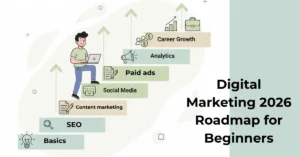
Digital Marketing 2026 Roadmap for Beginners
This digital marketing 2026 roadmap for beginners is designed to eliminate confusion and provide you with a clear path forward.
The biggest reason beginners fail is not lack of resources — it is lack of sequence. They try to learn everything at once and end up mastering nothing. Follow this roadmap instead:
1. Foundation (Weeks 1–3)
Understand what digital marketing is, how online businesses make money, customer journeys, and the difference between organic and paid marketing. No tools yet.
2. Choose one organic channel (Months 1–3)
Pick either SEO or social media marketing (not both). Learn it deeply. Practice it daily. Build one real project — a blog or a social account — and grow it.
3. Add a second channel (Months 3–5)
Once your first channel is producing results, add either content marketing, email marketing, or a second social platform.
Learn email automation, Google Analytics 4, and CRM tools. At this point, start applying for jobs, taking freelance clients, or using these skills to grow your own business.
Step-by-Step Guide to Learn Digital Marketing
Step 1: Build a Foundation in Digital Marketing
Before you touch any tool, spend two to three weeks just learning concepts. This is not a waste of time — it is what separates marketers who get results from those who stay stuck for years.
What to learn in this phase:
- The difference between traffic, leads, and conversions
- How a marketing funnel works (Awareness → Interest → Decision → Action)
- What organic vs. paid marketing means
- How search engines rank content (basic Google algorithm concepts)
- How social media algorithms work
Free resources: HubSpot Academy’s free “Digital Marketing” course covers all of this in under 6 hours. Google’s “Fundamentals of Digital Marketing” (offered through the Google Skillshop) is also excellent and provides a free certificate.
Step 2: Learn SEO, the most powerful long-term skill in digital marketing
SEO (Search Engine Optimization) is the act of getting your content ranked on Google without spending on paid advertisements. SEO is the most ROI-intensive skill set within digital marketing due to its nature of providing you with a completely free, organic, and ever-growing stream of traffic.
What skills should you acquire in SEO?
Keyword research — how to identify consumer queries
On-page SEO — title tags, meta descriptions, headings, internal links
Content SEO — creating articles that rank (search intent, article length, format)
Technical SEO — website loading speed, mobile optimization, Core Web Vitals
Off-page SEO — acquiring backlinks and increasing domain authority
Local SEO — ranking in “near me” search queries for brick-and-mortar businesses
How to practice: Create a blog on WordPress.com or Blogger for free. Publish 10 articles optimized for keywords with low competition. Monitor your SEO ranking results via Google Search Console. This is the most efficient method of learning SEO — by executing SEO on a live website.
Pro tip: Start with keywords that have search volume under 500/month and low competition. You will rank faster, see results sooner, and stay motivated. Growing a page to 100 organic visitors/month is worth more than any course certificate.
Step 3: Learn social media marketing
Social media marketing is how brands and creators build audiences on platforms like Instagram, LinkedIn, YouTube, and X (Twitter). In India, Instagram and YouTube are the highest-priority platforms for most niches. LinkedIn is essential for B2B and career growth.
What to learn:
- How algorithms decide what to show (reach, saves, shares, watch time)
- Content strategy — what to post, how often, and why
- Reels and short-form video — the highest-reach format in 2026
- Community building — engaging with followers, building trust
- Analytics — understanding what content is actually working
How to practice: Create a dedicated Instagram or LinkedIn page on any topic you know well. Commit to posting for 60 days consistently. Track what content gets the most saves and shares. The data will teach you more than any course.
Step 4: Learn content marketing and email marketing
Content marketing powers SEO and social media marketing. It is the creation of valuable content, blogs, videos, infographics, and tutorials that engages and holds the interest of your target audience. Email marketing is how you get those people to buy from you.
The return on investment from email marketing is better than for any other form of digital marketing. According to HubSpot, every ₹1 invested in email marketing generates ₹36 in revenue. Indian digital marketers should pay equal attention to WhatsApp marketing using platforms such as Wati and Interakt.
Key topics: lead magnets, landing pages, welcome emails, list segmentation, subject line A/B testing, open rate vs. click rate tracking.
Step 5: Learn paid advertising (Google Ads and Meta Ads)
Once you understand organic marketing, paid advertising becomes dramatically more effective. You already know what messaging works, who your audience is, and what content converts. Paid ads simply accelerate that.
Start with Meta Ads (Facebook + Instagram). The interface is beginner-friendly, budgets can start at ₹200/day, and the targeting options are unmatched for most consumer products and local services. Then learn Google Ads for search intent targeting — these are the people actively searching for what you offer right now.
Step 6: Learn analytics, measure everything
Digital marketing without analytics is guesswork. You must learn to track what is working and make data-driven decisions. In 2026, the two non-negotiable analytics tools are Google Analytics 4 (GA4) and Google Search Console.
With GA4, you can see where your website traffic comes from, how users behave on your site, what pages convert, and where people drop off. With Google Search Console, you can see which keywords you rank for, your click-through rates, and technical issues hurting your SEO.
Learn to track: traffic sources, bounce rate, session duration, conversion rate, cost per acquisition (CPA), and return on ad spend (ROAS) for paid campaigns.
Step 7: Use AI as a productivity tool, not a replacement for skill
In 2026, AI tools like ChatGPT, Gemini, and Perplexity are standard parts of a digital marketer’s workflow. This saves a lot of time spent on repetitive tasks. But they do not replace strategic thinking or real-world judgment.
Use AI for: generating content outlines, brainstorming keyword ideas, writing first drafts of ad copy, summarizing competitor articles, creating social media captions, and analyzing data faster.
Do not use AI for: publishing unedited content, replacing your own voice and expertise, or making campaign strategy decisions without reviewing the data yourself. AI-generated content that is not reviewed and edited will consistently underperform human-reviewed content in both SEO rankings and audience engagement.
Best Free Digital Marketing Courses and Certifications (2026)
1. Google Digital Marketing Fundamentals
40 hours. Covers SEO, SEM, social media, email, and analytics. Certificate recognized by employers globally. Available via Google Skillshop.
2. HubSpot Academy — Inbound Marketing
Covers content strategy, SEO, social media, email, and conversion optimization. One of the most respected free certificates in the industry.
3. Meta Blueprint
Official Facebook and Instagram advertising courses. Learn campaign setup, audience targeting, creative strategy, and measurement.
4. Google Analytics Certification
Learn GA4 from scratch. Covers traffic analysis, event tracking, conversion goals, and reporting. Offered free via Google Skillshop.
5. Semrush Academy
Excellent free SEO and content marketing courses taught by working practitioners. Covers keyword research, technical SEO, and link building.
Recommendation: Start with the Google Digital Marketing Fundamentals course. It is free, covers everything, and gives you a Google-backed certificate to add to your LinkedIn profile immediately. Then complete HubSpot’s Inbound Marketing certification as your second step.
Essential Digital Marketing Tools Every Beginner Should Learn
| Tool | Purpose | Cost | Priority |
|---|---|---|---|
| Google Search Console | Track SEO rankings, clicks, and technical issues | Free | ⭐ Essential |
| Google Analytics 4 (GA4) | Website traffic, user behaviour, conversions | Free | ⭐ Essential |
| Canva | Design social media posts, ads, thumbnails, and presentations | Free / ₹4,000/yr Pro | ⭐ Essential |
| Meta Ads Manager | Run Facebook and Instagram ad campaigns | Free (pay per ad) | ⭐ Essential |
| Google Ads | Run search, display, and YouTube ad campaigns | Free (pay per ad) | ⭐ Essential |
| Ubersuggest | Free keyword research and competitor analysis | Free tier / ₹290/mo | High |
| Mailchimp | Email marketing — build lists and send campaigns | Free up to 500 contacts | High |
| Ahrefs Webmaster Tools | Free backlink analysis and SEO audit for your own site | Free | High |
| Buffer / Hootsuite | Schedule and manage social media posts | Free tier available | Medium |
| ChatGPT | Content ideation, copywriting assistance, and research | Free / ₹1,700/mo Plus | Medium |
Start with just three tools: Google Search Console, Google Analytics 4, and Canva. Master these before adding anything else to your stack. Adding too many tools too early is one of the most common beginner mistakes.
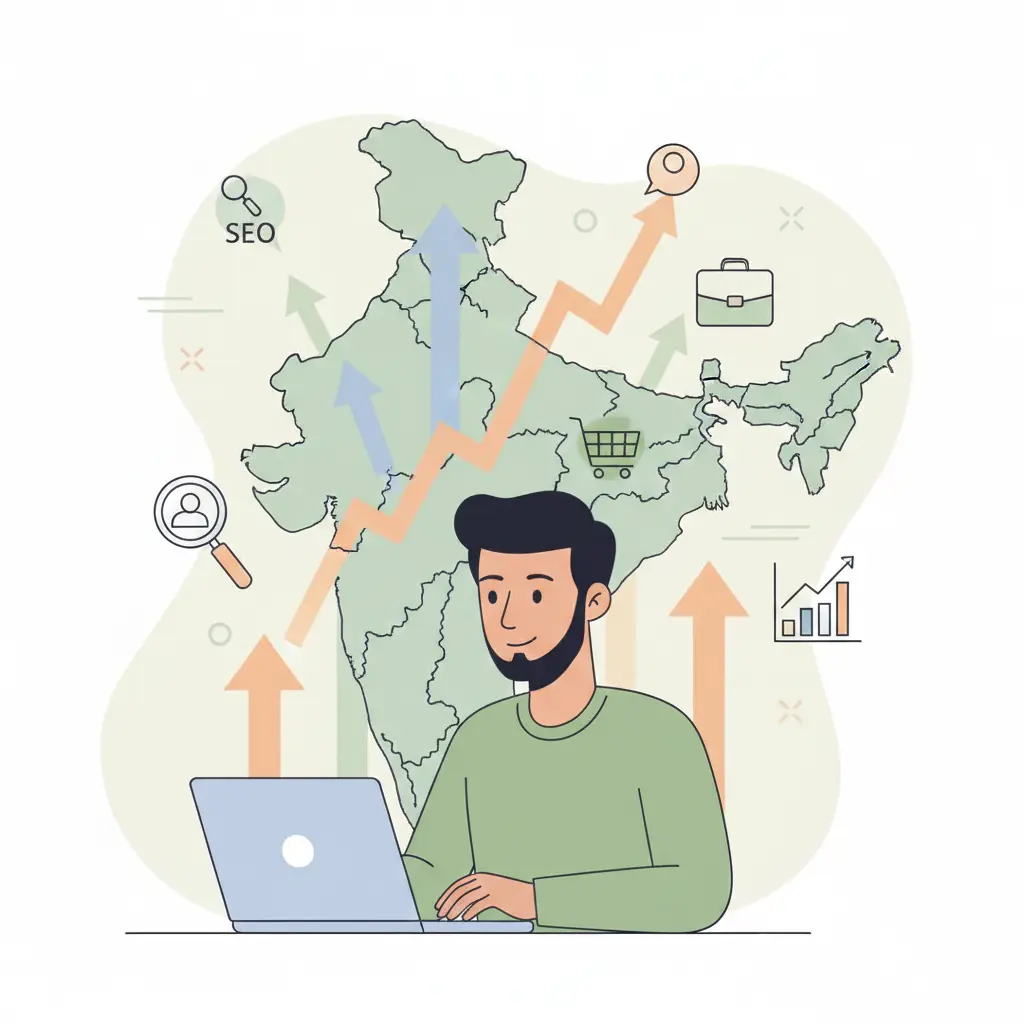
Digital Marketing Salary in India (2026 Data)
One of the most searched questions by beginners is: “How much does a digital marketer earn in India?” Here is an honest breakdown based on 2026 job market data:
| Role | Experience | Salary Range (LPA) | Freelance Income/Month |
|---|---|---|---|
| Digital Marketing Executive | 0–1 year (fresher) | ₹2.5 – 4.5 LPA | ₹15,000 – 30,000 |
| SEO Specialist | 1–3 years | ₹3.5 – 7 LPA | ₹25,000 – 60,000 |
| Social Media Manager | 1–3 years | ₹3 – 6.5 LPA | ₹20,000 – 50,000 |
| Performance Marketing Manager | 3–5 years | ₹8 – 18 LPA | ₹60,000 – 1,50,000 |
| Digital Marketing Manager | 5+ years | ₹12 – 25 LPA | ₹1,00,000+ |
| Head of Digital / VP Marketing | 8+ years | ₹20 – 50+ LPA | Agency/retainer model |
City-wise variation: Salaries in Mumbai, Bengaluru, and Delhi NCR are 20–40% higher than the national average. Remote work has narrowed this gap significantly since 2023, and many digital marketing roles can now be done fully remotely.
Career Paths in Digital Marketing
Digital marketing is not a single career — it is a collection of specializations. Here are the main paths you can take:
The 6 main career paths in digital marketing
- SEO Specialist / Strategist — Focused on organic search rankings. High demand, can be fully remote, strong freelancing potential.
- Performance Marketer / PPC Specialist — Runs paid campaigns on Google and Meta. High-paying specialization, especially for e-commerce brands.
- Social Media Manager / Strategist — Builds and manages brand presence on social platforms. Entry-level friendly.
- Content Marketer / Strategist — Creates and distributes content (blogs, videos, newsletters). Blends writing and SEO skills.
- Email Marketing Specialist — Manages subscriber lists, automation sequences, and campaign performance. High ROI skill.
- Digital Marketing Manager / Generalist — Oversees all channels. Typically, a 4–6 year career milestone with strong salary growth.
Most people start as generalists and specialize over time. The most in-demand and highest-paid specialization in India right now is performance marketing (paid ads + analytics), followed by SEO.
Common Mistakes Beginners Make (And How to Avoid Them)
- ❌ Trying to learn all channels at once — leads to surface-level knowledge across everything and mastery of nothing
- ❌ Starting with paid ads before understanding organic — wastes money and teaches bad habits
- ❌ Learning only theory without building anything — you cannot learn to swim by reading about water
- ❌ Buying expensive courses before trying free ones — Google, HubSpot, and Meta’s free resources are better than most paid courses for beginners
- ❌ Not tracking data — if you are not measuring it, you cannot improve it
- ❌ Expecting fast results — SEO takes 4–8 months, social media growth takes 3–6 months of consistency
- ❌ Using AI without editing — AI drafts are starting points, not finished work. Unedited AI content performs worse in both rankings and engagement
- ✓ Following a structured roadmap and completing each step before moving on
- ✓ Building real projects and documenting results in a portfolio
- ✓ Getting certified with free courses while you practice
How Long Does It Take to Learn Digital Marketing?
Here is a realistic timeline if you practice for 1–2 hours per day:
| Milestone | Realistic Timeline | What you can do at this stage |
|---|---|---|
| Understand the basics | 2–4 weeks | Explain digital marketing to someone else, understand channels and funnels |
| First channel competence | 2–3 months | Manage a basic SEO or social media strategy for a small brand |
| Job-ready skills | 4–6 months | Apply for digital marketing executive roles, and take freelance clients |
| Intermediate practitioner | 8–12 months | Run multi-channel campaigns, analyze data, manage small teams |
| Senior/specialized | 2–3 years | Lead campaigns, train juniors, command ₹8–18 LPA salaries |
The most important variable is not how long you study, but whether you are building real projects while you learn. Someone who spends 3 months writing blog posts and tracking their SEO results will outperform someone who spends 6 months watching tutorials and never publishes anything.
Best Way to Practice Digital Marketing Skills
Learning digital marketing skills requires practice to learn how to learn digital marketing step by step.
You can:
- Start a free blog
- Create an Instagram page
- Run mock ad campaigns
- Help a local business
Practice is the best way to build confidence and increase job opportunities.
For instance:
A beginner helped a nearby local business by managing its social media page. By applying basic content and engagement strategies, the business saw increased inquiries. This real project helped the beginner build confidence and a strong portfolio.
Frequently Asked Questions
Can I learn digital marketing in 3 months?
Which is the best free platform to learn digital marketing?
Is digital marketing hard to learn?
What is the salary of a digital marketer in India in 2026?
How to learn digital marketing for free?
Do I need a degree to get a digital marketing job?
Which digital marketing skill has the highest salary in India?
Final Words from MarketYug
Learning digital marketing step by step in 2026 is genuinely achievable without spending money on courses, without a marketing degree, and without any prior experience. What it does require is structure, consistency, and real practice.
Follow the roadmap in this guide. Start with one channel. Build something real. Track your results. Get the free certifications. And when you are ready, whether that is a job, freelancing, or growing your own business, you will have both the skills and the proof to back yourself up.
MarketYug publishes practical, free digital marketing guides designed for Indian beginners. If this article helped you, explore our other guides below: