What is Digital Marketing in Simple Words? (Easy Guide for Beginners 2026)
In simple terms, digital marketing is any marketing that happens on the internet or through electronic devices. That’s it at its core. However, as you will see in this guide, understanding what it is, how it works, and why it matters in India in 2026 will change how you view every business you engage with online.
When I first started learning marketing in college, I searched for “what is digital marketing in simple words.” I found articles filled with jargon, and I closed the tab in 30 seconds. That frustration led me to create MarketYug, and it’s why I’m writing this guide the way I wish someone had explained it to me.
By the end of this article, you will know the following:
• What digital marketing really means (with clear examples)
• How it differs from traditional marketing
• All the main types and what each one does
• How to start learning it from scratch
• What career and business opportunities are available to you right now
Table of Contents
- What Is Digital Marketing? (The Simple Definition)
- Digital Marketing vs Traditional Marketing
- Why Digital Marketing Matters in India in 2026
- The 7 Main Types of Digital Marketing Explained
- How Digital Marketing Actually Works — Step by Step
- Real-Life Examples of Digital Marketing in India
- How to Learn Digital Marketing Step by Step
- Skills You Need (and Which Ones You Already Have)
- Career and Business Opportunities
- Frequently Asked Questions
Digital Marketing for Beginners
Digital marketing for beginners starts with the single idea that people spend most of their time online. They search Google, watch videos on YouTube, browse Instagram, and chat on WhatsApp. Digital marketing is all about learning how businesses can appear on these platforms at the right time and in front of the right people using simple online strategies.
For instance:
If you search for something on Google and click on a website, that website is practicing digital marketing.
If you see an advertisement on Instagram, that is also digital marketing.
Beginners do not require any coding or complex equipment. You only need to grasp how people behave online and how they access content. This makes digital marketing one of the simplest things to learn today. What is digital marketing in simple words?
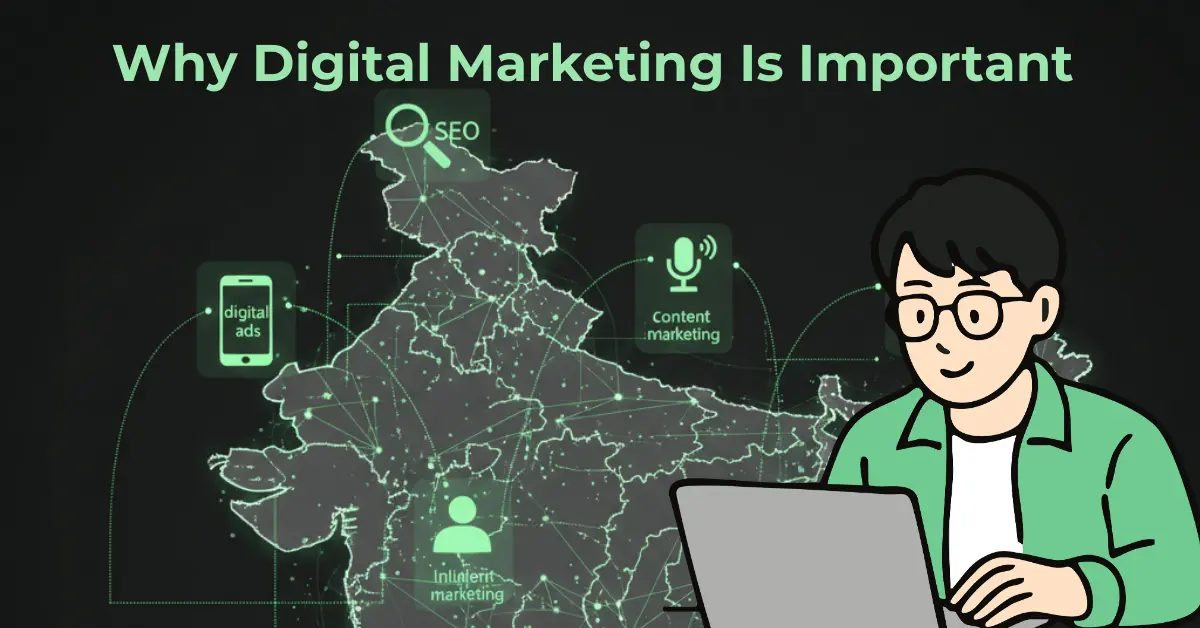
Importance of Digital Marketing in India
India has over 900 million internet users as of 2026, and that number continues to grow.
Here’s what this means for you and your business:
Your customers are already online. Whether they are in Mumbai, Jaipur, Raipur, or a tier-3 town, they search Google, watch YouTube, scroll through Instagram, and make purchase decisions online. If your business is not visible there, a competitor is.
The cost barrier has dropped. Ten years ago, only large companies could afford TV commercials and full-page newspaper ads. Today, a student in Jaipur with no budget can build a personal brand on Instagram, rank a blog on Google, and start earning, all for free. The playing field has never been more even.
India’s digital economy is expected to reach $1 trillion by 2028. Businesses that establish digital foundations now are setting themselves up for significant growth. Those who wait are falling behind.
Digital skills are the most sought-after career skills in India right now. Companies of all sizes, from Tata to five-person startups, are hiring SEO specialists, content writers, social media managers, and performance marketers. Fresh graduates with strong portfolios can earn between ₹25,000 and ₹60,000 per month in entry-level digital marketing roles.
The India-specific advantage: In India, regional language content is booming. Hindi, Tamil, Telugu, Bengali — audiences in these languages are underserved online. Creators and businesses that produce quality regional content face much less competition and often rank faster on Google than English-language sites.
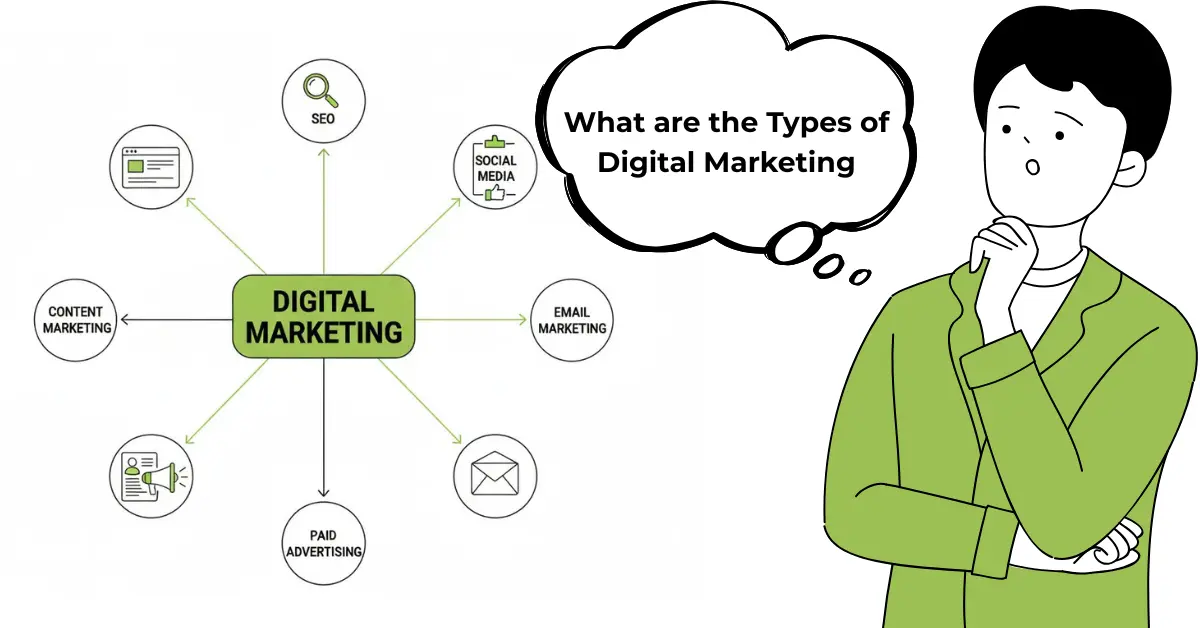
What are the Types of Digital Marketing?
When I started learning digital marketing, in simple words, I quickly realised one important thing: what are the types of digital marketing? There are many channels involved, each helping a different business need. Based on our experiences with small businesses and creators.
Search Engine Optimization (SEO)
SEO helps your website show up on search engines like Google when people look for solutions. For instance, a local service provider, such as a repair shop, can receive daily inquiries just by ranking for “best repair shop near me.” This traffic is free and continues over time as rankings improve. Once you search it yourself, you will understand.
If you want to learn how SEO actually works step by step, check out our complete guide 👉 “What is SEO and How It Works“.
Social Media Marketing
Social media marketing uses platforms like Instagram, Facebook, and LinkedIn to increase visibility and build trust. For instance, a home-based clothing seller can create reels on Instagram, respond to comments, and convert followers into customers without having a website.
Content Marketing
Content marketing is about creating helpful material, such as blog posts, videos, guides, and tutorials. Many blogs and YouTube channels succeed by addressing common issues. When people find useful solutions, they start trusting the brand and often return, which can lead to sales or leads later.
Email Marketing
Email marketing helps keep long-term relationships strong. For instance, an online course creator can send weekly tips, updates, or offers to subscribers. Over time, this builds authority and keeps the audience interested without relying on algorithms.
Paid Advertising
Paid advertising includes platforms like Google Ads and Facebook ads. For instance, a new startup launching a product can run ads to gain quick visibility and attract early customers while working on SEO.
From my experience, the best results come when these channels work together. SEO and content build trust and authority over time, while social media and paid ads draw attention more quickly. Understanding these types helps beginners find the right path based on real business goals, not just theory.
How Digital Marketing Works in Real Life
Digital marketing includes technology, creativity, and data. When someone searches for something online, the platforms begin to gather information about the user’s interests and behaviour. Marketers use this information to show relevant content or ads to the user. This is how digital marketing works in real life, by connecting the right message with the right person at the right time.
Let me show you a real example that happens every day in India.
Suppose a woman in Pune runs a home-based pickle business. She makes amazing achaar, and her neighbours love it. However, she only sells to 20 families.
Here is how digital marketing transforms her business:
Step 1: She creates a Google Business Profile. Now, when someone in Pune searches for “homemade achaar near me,” her business shows up on Google Maps. She receives 5 new inquiries in the first week, all for free.
Step 2: She posts on Instagram three times a week. She shares short videos of herself making pickles, with captions in Hindi and English. People share her posts. A food blogger reposts her content. She gains 800 followers in a month.
Step 3: She starts a WhatsApp broadcast list. Every time she has a new batch ready, she sends a message to 150 customers. Within 24 hours, 30 of them place orders.
Step 4: She asks customers to leave Google reviews. More reviews lead to a higher ranking on Google, which brings in more customers. This starts a cycle.
She did not run any paid ads or hire an agency. She used four free digital marketing tools and grew her customer base from 20 to 200 in just three months.
This is how digital marketing works in real life; it is about being present where your customers already are.
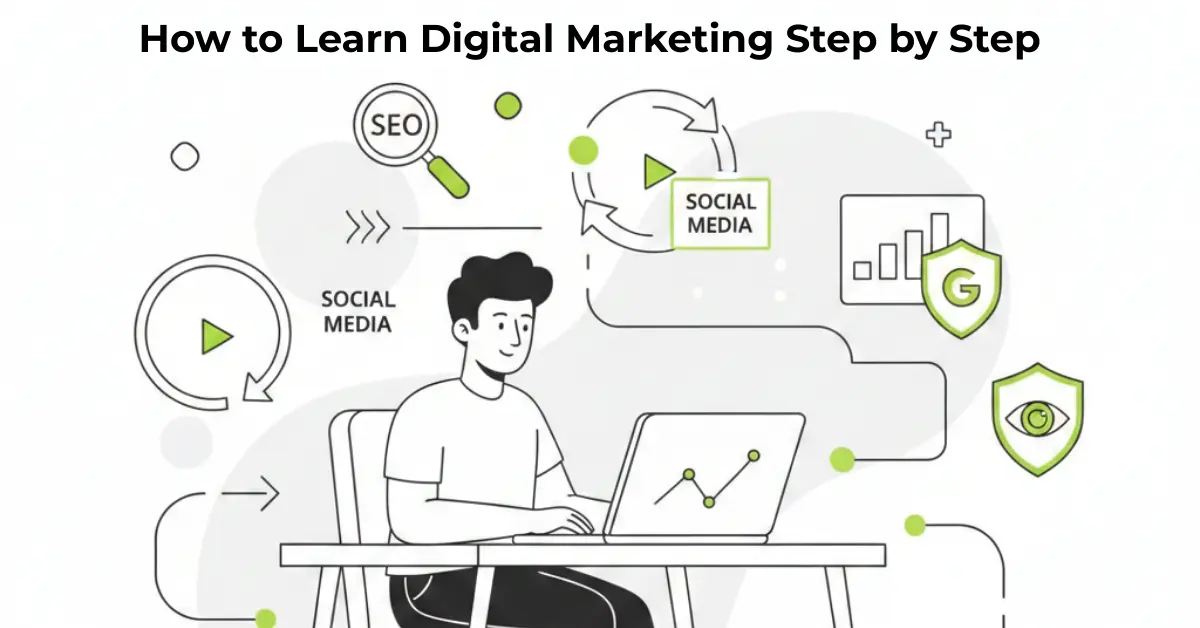
How to Learn Digital Marketing Step by Step
Many newbies ask me how to learn digital marketing in a step-by-step process. I have observed one thing: it becomes easier when you have a plan to follow rather than jumping around from one topic to another. Direction is important.
This is the exact path I wish someone had shown me when I started.
Step 1: Build your foundation first (Week 1–2)
Do not jump into tools and tactics. Start by understanding the basics:
What is a search engine, and how does it rank pages?
How do social media algorithms decide what to show people?
What makes someone click an ad versus scroll past it?
These questions may seem simple, but knowing the answers sets strategic marketers apart from those who just post content and hope.
Step 2: Pick one channel and focus (Month 1–3)
The biggest mistake Newbies make is trying to learn everything at once. SEO, Instagram, email, and ads all at the same time. They end up knowing a little about everything but are not experts in anything.
Choose the one channel that fits your goals:
Want to write? Start with SEO and content marketing.
Like creating short videos? Start with Instagram or YouTube.
Interested in data and numbers? Start with Google Ads.
Focus on that one thing until you can produce results. Then expand.
Step 3: Practice on a real project (Month 2 onwards)
Reading about digital marketing is not the same as doing it. Start something: a blog about a topic you care about, an Instagram account for a hobby, a small YouTube channel. It should not be perfect but practical because it is real practice.
Step 4: Track results and improve
Every platform gives you data. Use it. Check which posts get the most engagement. See which blog articles rank on Google. Notice what subject lines get people to open your emails.
Adjust based on evidence, not gut feeling. This habit alone will put you ahead of 80% of people who call themselves digital marketers.
Step 5: Build a portfolio before looking for clients or jobs
When you are ready to earn, either as a freelancer or an employee, do not just send a resume. Create a portfolio that shows real results. “I grew my Instagram from 0 to 2,000 followers in 90 days” or “I ranked my blog article on page 1 of Google for this keyword” is worth more than any certification.
Career and Income Opportunities in 2026
Digital marketing opens several distinct career paths. Here is a realistic breakdown of what each pays in India in 2026:
| Role | Fresher Salary (Monthly) | Experienced (3+ years) |
|---|---|---|
| SEO Specialist | ₹20,000–₹35,000 | ₹60,000–₹1,50,000 |
| Social Media Manager | ₹18,000–₹30,000 | ₹50,000–₹1,20,000 |
| Content Writer / Strategist | ₹15,000–₹30,000 | ₹50,000–₹1,50,000 |
| Performance Marketer | ₹25,000–₹45,000 | ₹80,000–₹2,50,000 |
| Email Marketing Specialist | ₹20,000–₹40,000 | ₹60,000–₹1,80,000 |
| Digital Marketing Manager | ₹35,000–₹60,000 | ₹1,00,000–₹3,00,000 |
Freelancing reality check: Many freelancers in India charge ₹5,000 to ₹25,000 per month per client for basic digital marketing packages. With 5 clients, a part-time freelancer earns ₹25,000 to ₹1,25,000 per month, often while working a full-time job or studying.
Building your own brand: The highest earners in Indian digital marketing are not employees. They are creators who built audiences through blogs, YouTube channels, or Instagram and monetized them through courses, affiliate commissions, and consulting. This takes 12 to 24 months of consistent effort, but the upside is uncapped.
Skills Required for Digital Marketing
After 3 years of practicing and teaching digital marketing, here are the skills I believe actually matter. I will also be honest about which ones are overrated.
Skills that genuinely matter:
Writing clearly. Almost every area of digital marketing, including SEO, content, email, social media, and ads, requires you to write clearly and persuasively. This is the single most important skill you can develop.
Basic data literacy. You do not need to be a data scientist, but you should be comfortable reading a Google Analytics report, understanding what a conversion rate means, and spotting trends in a spreadsheet.
Understanding people. What does your audience want: problems, language? Empathy and curiosity are the most underrated skills in marketing.
Learning speed. Algorithms change, and platforms rise and fall. What worked in 2023 might not work in 2026. The marketers who succeed are the ones who adapt quickly, not the ones who know the most tricks today.
Skills that are overrated for beginners:
Graphic design. Canva handles 90% of what beginners need. You do not need to learn Photoshop.
Coding. Unless you want to dive deep into technical SEO or build your marketing tools, you do not need to code.
Every certification available. Certifications show effort, not skill. A Google Analytics certificate is useful on a resume, but a portfolio of real results is far more convincing to any employer or client.
Career and Business Opportunities
Digital marketing provides various opportunities for a career or business. You can work as a freelancer, get a job, start an agency, or build your brand. Businesses like digital marketing because it is measurable and cost-effective.
Beginners can earn money online, help local businesses, or build their brands with the right skills. This flexibility makes digital marketing popular among students and professionals.
Final Thoughts from MarketYug
Understanding the digital marketing beginner guide (Step-by-Step + Free Tools) is the first step to success online. Digital marketing is not complicated if you break it down and practice it regularly. It is essential for helping people and businesses grow in the digital world.
At MarketYug, I aim to make digital marketing easy for beginners. I want to help you learn digital marketing step by step and with confidence. If you are starting today, you are already ahead of many. So you understand what is digital marketing in simple words.
Hi there, I log on to your blog like every week. Your humoristic style is awesome, keep doing what you’re doing!
Thanks for sharing your thoughts on титан недвижими имоти.
Regards
Wonderful blog! Do you have any tips and hints for aspiring
writers? I’m planning to start my own site soon but I’m
a little lost on everything. Would you advise starting with a free
platform like WordPress or go for a paid option? There are so many choices out there that I’m totally confused
.. Any ideas? Cheers!
Thanks for the kind words! If you’re just getting started, platforms like Blogger or Medium can be great free options to learn the basics and start publishing without worrying about hosting or technical setup. However, if you’re planning to build a long-term website or personal brand, I’d recommend WordPress with your own domain and hosting because it gives you more control and flexibility as you grow. You can always start free, learn what works for you, and upgrade later. Best of luck with your new site!
Hi there Dear, are you actually visiting this site on a regular basis, if so afterward you will
without doubt get good experience.
Your website has certainly supplied me with simply the data that
I actually needed. We currently have been doing exploration upon this kind of
subject matter for quite a while, and it has taken a very long while to find
a blog page that gives all of the facts that I will need.
I actually start looking forward to browsing more blogs authored by you in the
future, and will certainly take a look right here first
next time I have got a investigative report.
Hi my loved one! I wish to say that this article is amazing,
great written and come with almost all significant infos.
I’d like to see extra posts like this .
This is simply not the first moment in time I spotted a website that was deserving of participating in a
comment section on. This particular short article is significant to me.
I really live a life-style of a good number of modes; that is to say that my work functions are distinct.
I perform Postpartum Massage Therapy. Besides that, I buy and sell collectibles.
I’m acquiring knowledge of Centos8. And, that’s merely a handful of activities
I do. At any rate, my idea is, each of us considers a subject from a unique point of view.
Pretty much every experience we have patterns us and our perspective
of our own selves and the community all around you and me.
I think uncovering some kind of greater experience of actuality is exactly where almost everything the majority of us dialogue about brings us to.
That being said, just how will men or women afterward relate?
Is it actually possible? I believe each of our unique contributions to the Internet Commons changes a great many citizens, probably.
Hence think about that, bloggers and folks leaving comments.
Your current brief review may perhaps help a different inividual.
Or even, responses can certainly accomplish the complete opposite.
Plus, everyone, meaning, you, me, in fact need to care to
try to support others to develop and in no way suffer.
Thank you for this specific blog page; I actually am submitting this blog together with my various other superior websites I’ve uncovered that I sometimes troubled to opine on. Always keep
producing! Keep revealing!